
Organizations are increasingly turning to managed service providers to bridge the gap between AI ambition and execution. That’s according to KPMG’s 2026 Managed Services Outlook, which found that 91 percent of organizations now see managed services as critical to delivering AI at scale.
The report shows that what was once a business model that focused on cost control is quickly becoming a central pillar of digital transformation. The shift reflects a growing recognition that AI is not just another layer of technology. It is a capability that cuts across infrastructure, data, governance, and business processes—and one that is difficult to operationalize without external expertise.
The report’s authors say that businesses are increasingly using managed services “to quickly unlock the value of artificial intelligence,” highlighting a move away from purely internal delivery models toward more collaborative, outcome-driven approaches. While they view ‘managed services’ as a broad range of provision, the findings are highly relevant to traditional IT-focused MSPs and MSSPs.
Measuring ROI from managed services
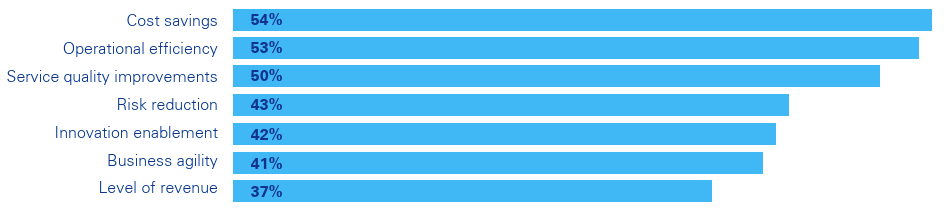
It’s no surprise that cost savings and operational efficiency are the key ROI metrics that organizations expect from managed services. Of greater note is that service quality improvements are close behind, suggesting that companies do not see outsourcing and reduction in quality as inevitable—quite the opposite.
Risk reduction is the fourth most important ROI metric, something worth remembering when putting together your next proposal pack. Also of note is that innovation enablement and business agility outrank revenue generation as measures of ROI.
KPMG data.
Why organizations shift to managed services
Despite the enthusiasm surrounding AI, many organizations remain constrained by legacy systems, fragmented data environments, and persistent skills shortages. The KPMG report highlights these familiar barriers—tech debt, talent gaps, and the challenge of turning experimentation into production—as key reasons why companies are seeking external support. Managed services, in this context, are less about delegation and more about acceleration, enabling businesses to move faster than their internal capabilities would otherwise allow.
This is particularly relevant in Europe, where regulatory requirements, from GDPR to emerging AI legislation, add further layers of complexity. Here, the role of the MSP extends beyond technical delivery into governance, compliance, and risk management. It is no coincidence that cybersecurity and AI management emerge in the research as the two areas expected to deliver the greatest value from managed services, both today and in the coming years. As AI systems become more deeply embedded in business operations, the need to secure, monitor, and govern them becomes inseparable from the technology itself.
AI is now THE critical factor
AI is reshaping the criteria by which providers are selected. The report identifies AI capability as the single most important factor for buyers when choosing a managed services partner, ahead of more traditional considerations such as cost or operational efficiency. This marks a significant departure from earlier models, where pricing and labor reduction often dominated decision-making. Today, organizations are looking for providers who can combine advanced technology with domain expertise and strategic insight.
KPMG’s analysis reinforces this point, noting that leading providers succeed by pairing AI capabilities with “a deep understanding of the business,” rather than offering generic, one-size-fits-all solutions.
Opportunities for every size of MSP
For MSPs of all sizes, this presents a nuanced challenge. The rise of AI may appear to favor larger providers with extensive resources, but the reality is more complex. While scale matters, so too does specialization. Smaller and mid-sized MSPs can compete effectively by focusing on specific industries, building deep expertise, and delivering tailored solutions that align closely with customer needs. In a market where generic AI offerings are increasingly viewed with skepticism, this kind of differentiation can be a powerful advantage.
Trust, meanwhile, is emerging as a defining factor. As organizations entrust providers with ever more critical systems and data, confidence in their ability to deploy AI responsibly becomes paramount. The KPMG research points to a growing emphasis on transparency, governance, and security, with buyers seeking reassurance that AI will be used in a controlled and auditable manner. In Europe, where regulatory scrutiny is particularly intense, this focus on trust is likely to become even more pronounced.
MSPs will recognize the implications of this by now: the opportunity is significant, but so too are the expectations. Success will depend not only on technical capability alone, but on the ability to combine technology, expertise, and trust into a coherent offering that delivers real business outcomes.
In that sense, AI is not just accelerating the use of managed services. It is redefining what those services need to be.
The MSP landscape is shifting fast. Get ahead by joining the brightest and the best at MSP GLOBAL. Your first step? Sign up for the newsletter to get your free ticket code and save €€€s.