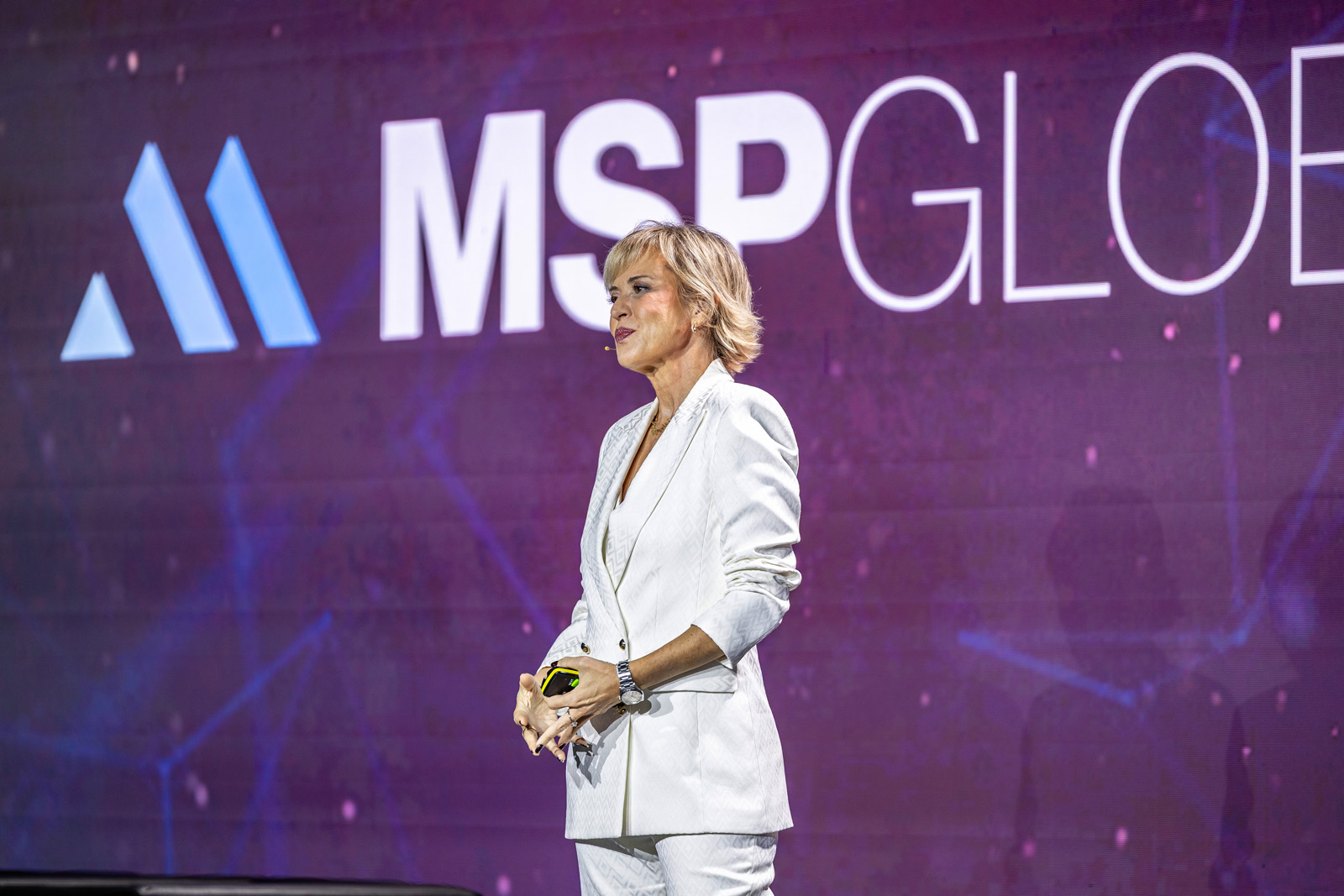
Businesses are racing to adopt AI and calling on MSPs to help them. But according to Carme Artigas, one of Europe’s most influential voices in digital policy, the biggest barrier to AI adoption isn’t innovation—it’s trust.
At MSP GLOBAL 2025, Artigas took the stage to decode one of the most discussed pieces of legislation in modern tech: the EU AI Act. Her session cuts through the noise around regulation and delivers something far more useful for Managed Service Providers—a roadmap for opportunity.
Watch the full session below, then read on for the lessons every MSP should be thinking about right now.
The AI policy maker explains the law
Carme Artigas is not just another policy commentator. As Spain’s former Secretary of State for Digitalization and Artificial Intelligence and a leading architect of the EU AI Act, she played a direct role in shaping Europe’s regulatory approach to AI. Her perspective matters because it sits at the intersection of government strategy, innovation policy, and real-world technology deployment.
Her central message to MSPs was clear: regulation is not arriving to slow AI down. It is arriving to make adoption possible. Put another way: AI needs trust before it can scale.
Artigas makes a simple but powerful observation: every technological revolution has required regulation to unlock mass adoption. From industrial machinery to telecommunications to automotive safety, governance followed innovation—not to stop it, but to make society comfortable enough to embrace it.
AI, she argues, is different only in scale.
Unlike previous waves of technology, generative AI affects every industry simultaneously while also reshaping how humans interpret reality itself. Deepfakes, synthetic media, and automated decision-making introduce risks that go beyond productivity—they challenge trust in information, institutions, and digital systems.
“If people don’t trust a black box, they won’t adopt it,” she explains.
For MSPs, this insight reframes compliance entirely. Governance is no longer a checkbox exercise. It becomes a commercial enabler.
The EU AI Act regulates risk—not innovation
One of the most misunderstood aspects of the EU AI Act is what it actually regulates. According to Artigas, the law does not regulate AI itself. Instead, it regulates high-risk uses of AI.
That distinction matters enormously for service providers.
Around 90 percent of AI use cases will not fall into high-risk categories. The regulation focuses on applications that impact safety, fundamental rights, employment decisions, healthcare, education, or critical infrastructure.
In practical terms, most MSP-led deployments—automation, customer service AI, operational analytics, productivity tools—remain largely unaffected beyond transparency requirements.
The opportunity lies in helping customers understand where risk begins and how compliance creates competitive advantage.
Data sovereignty becomes Europe’s strategic advantage
A major theme throughout the talk was data sovereignty. Artigas sees Europe’s future AI success coming from control of industrial data rather than competing with hyperscalers on model size.
Europe’s competitive strength, she argues, is its vast base of industrial, manufacturing, and enterprise data—and the push to keep that data processed within European infrastructure.
European Cloud environments, sovereign data platforms, and compliant AI infrastructure will become essential building blocks for businesses navigating regulation. MSPs positioned as trusted local partners can become the bridge between global AI capabilities and regional compliance requirements.
In other words, sovereignty is not just policy—it is a market.
Five takeaways for MSP
Compliance will drive adoption, not slow it
Organizations hesitant about AI are waiting for clarity. MSPs that understand governance frameworks will unlock stalled projects and accelerate deployments.
Most AI use cases remain low risk
The EU AI Act targets specific high-risk scenarios. MSPs should help customers map workloads correctly rather than assume blanket restrictions.
Transparency becomes a service opportunity
Clients will need visibility into how AI systems work, what data they use, and whether outputs are AI-generated. Advisory and auditing services will grow quickly.
Data sovereignty favors regional providers
European infrastructure, sovereign Cloud strategies, and localized compliance expertise position MSPs as essential partners in AI rollouts.
Skills—not tools—will define winners
Focus on reskilling and augmentation rather than replacing human workforces. MSPs that invest in AI governance expertise will differentiate faster than those focused only on tooling.
Why this moment matters
Perhaps the most important takeaway from the session is conceptual. Artigas argues that regulation is not a defensive move—it is a strategic one.
Without trust, AI remains confined to experimentation. With trust, it becomes mainstream infrastructure.
And that transition creates demand for exactly the services MSPs provide: implementation, governance, integration, and ongoing operational assurance.
As Europe invests billions into AI infrastructure, data spaces, and innovation sandboxes, MSPs are uniquely positioned to turn policy into practical business outcomes.
The question is no longer whether regulation will shape AI adoption. It is whether providers are ready to lead customers through it.
Stay ahead of what’s next
MSP GLOBAL returns October 21-22, 2026, with deeper insight into AI, Cloud, security, and the evolving role of service providers in a regulated digital economy.
Subscribe to the MSP GLOBAL newsletter to get early registration details, exclusive offers, and first access to speaker announcements for the 2026 festival.